

The fridge is the one appliance in a UAE kitchen that never gets a day off, and spills, sticky drawers and odd smells build up quietly behind the door. It matters for more than looks: the World Health Organization estimates that almost 1 in 9 people worldwide fall ill from contaminated food every year, and the US FDA advises keeping the fridge at 40°F (about 4°C) or below. This guide shows how to clean inside a fridge step by step, what not to use, how often to do it and when to add it to a professional clean.
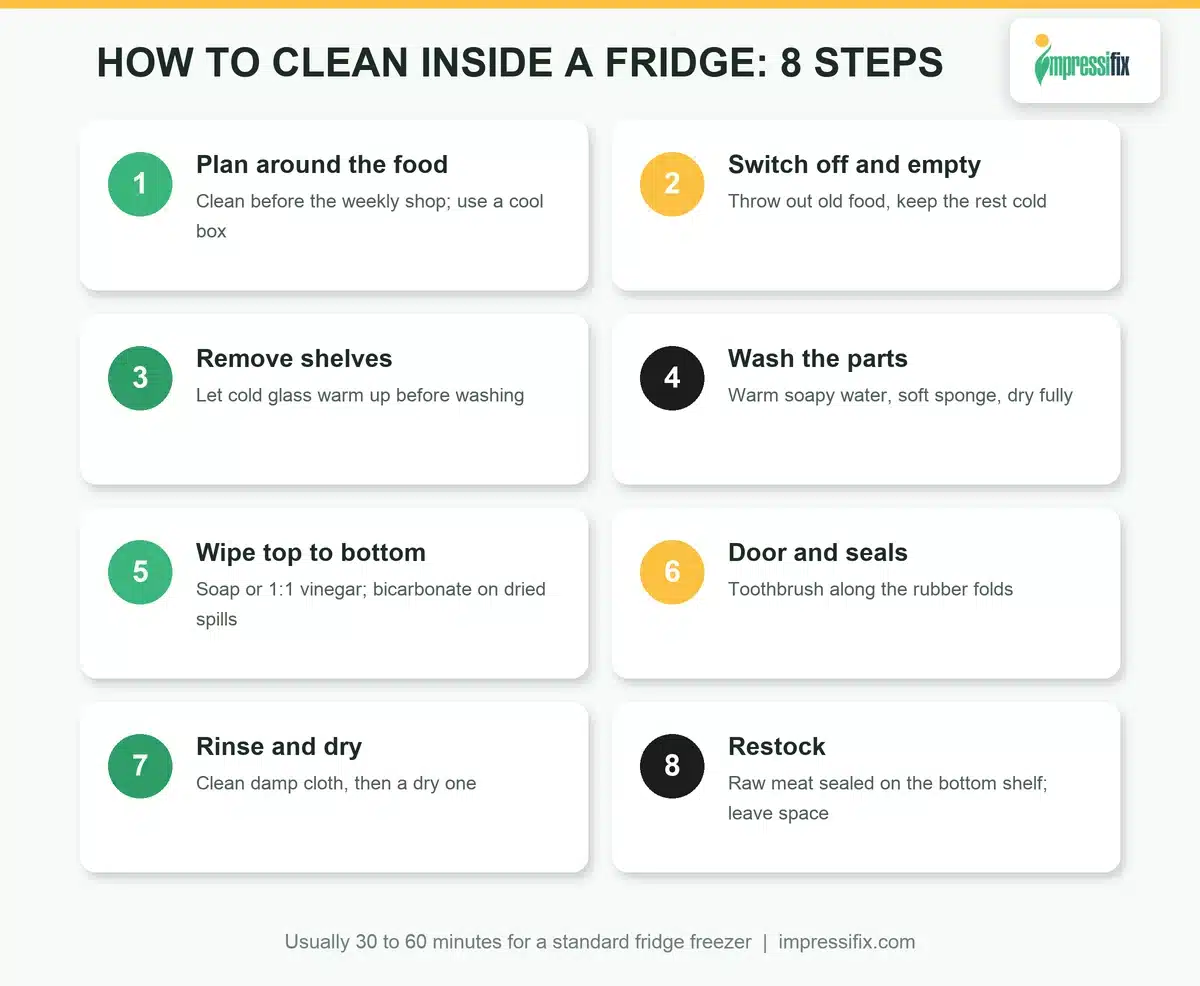
For most homes, cleaning inside the fridge takes 30 to 60 minutes: empty it, wash the shelves and drawers in warm soapy water, wipe the inside top to bottom with mild soap or a vinegar and water mix, clean the door seals, then dry everything before the food goes back. A quick weekly check keeps it that way.
What you need
You do not need special products. Most of the job is done with things already under the sink.
| Item | What it is for |
|---|---|
| Cool box or bags with ice packs | Keeps food cold while the fridge is empty |
| Warm water and washing up liquid | Shelves, drawers and the inside walls |
| White vinegar (1 part to 1 part water) | Grease film and light odours on hard surfaces |
| Bicarbonate of soda (baking soda) | A gentle paste for dried spills; an open box absorbs smells |
| Soft cloths and a non scratch sponge | Wiping without marking plastic liners |
| An old toothbrush | Door seals, shelf rails and the drain hole |
| Dry tea towel or microfibre cloth | Drying, so no water is left to freeze or grow mould |
Want a fixed price for your home?
Tell us your home size and area and a vetted team gets back with an exact quote, usually the same day.
How to clean inside a fridge, step by step
1. Plan around the food
Clean the fridge just before your weekly shop, when it is emptiest. In a UAE summer, speed matters: the FDA’s cold facts about food safety say perishable food should not sit out for more than two hours, or one hour when it is above 32°C.
2. Switch off and empty it
Turn the fridge off or unplug it if the door will be open for a while. Take everything out, throw away food that is past its date or looks doubtful, and put the rest in the cool box.
3. Take out shelves and drawers
Remove every shelf, drawer and door rack that comes out. Let cold glass shelves warm up to room temperature before washing them, because hot water on cold glass can crack it.
4. Wash the removable parts
Wash shelves and drawers in warm soapy water in the sink, using a soft sponge on sticky patches. Rinse, then dry them fully.
5. Wipe the inside top to bottom
Work from the top shelf down so drips fall onto areas you have not cleaned yet. Use warm soapy water or the vinegar mix, soften dried spills with a bicarbonate paste for a few minutes, then wipe them off. Clean the back wall and the small drain hole near the bottom, which can block and leave water under the drawers.
6. Clean the door and seals
Wipe the door shelves, then run a toothbrush dipped in soapy water along the folds of the rubber seal, where crumbs and mould collect. A clean seal also closes better, which keeps the cold in.
7. Rinse and dry
Wipe every surface with a cloth dampened in clean water to remove soap or vinegar, then dry it. Water left behind can freeze on the back wall or leave mould in corners.
8. Switch on and restock
Switch the fridge back on, let it cool, and put food back in its zones, with raw meat in a sealed container on the bottom shelf. Leave space between items: the FDA notes that cold air must circulate around food to keep it properly chilled.
What not to use inside a fridge
- Bleach and strong disinfectants. They leave a smell that food can pick up, and bleach must never be mixed with other cleaners; Health Canada warns that mixing bleach with other products releases toxic gases.
- Abrasive scourers and powders. They scratch plastic liners and shelves, and scratches hold dirt.
- Scented sprays and polishes. Food absorbs strong scents, especially butter, milk and cut fruit.
- Very hot water on cold glass. Let shelves warm up first.
- Sharp tools on ice. If the freezer has built up ice, defrost it as the manual says rather than chipping it off.
If you prefer gentler products in a home with children, our guide to non toxic cleaning products in the UAE explains what to look for on the label.
How often to clean your fridge
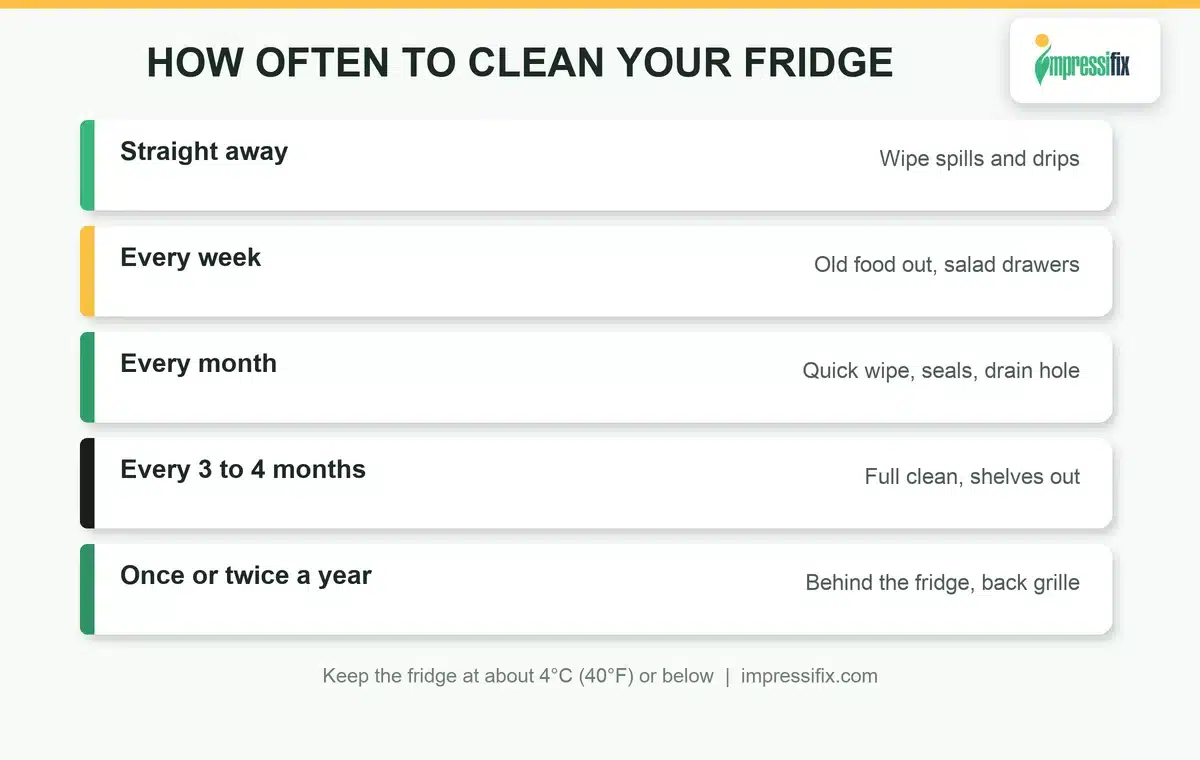
Little and often is easier than one big clean. The FDA’s advice on storing food safely is to clean the fridge regularly and wipe up spills straight away, because Listeria bacteria can grow even at fridge temperatures.
| How often | What to do |
|---|---|
| Straight away | Wipe spills, especially drips from thawing meat |
| Every week | Throw out old food, check the salad drawers, wipe handles and the busiest shelf |
| Every month | A quick full wipe inside, door seals and the drain hole |
| Every 3 to 4 months | The full step by step clean above, with shelves and drawers out |
| Once or twice a year | Pull the fridge out where safe, vacuum dust from the back or bottom grille and clean the floor behind it (check your manual) |
Good moments for the full clean are before Ramadan, before guests arrive for Eid or a party, and after a power cut. Our weekly cleaning checklist keeps the fridge on the monthly list so the weekly one stays short.
Keeping the fridge fresh
- Keep food covered. Sealed containers stop smells and drips spreading.
- Use the right zones. Raw meat and fish on the bottom shelf, ready to eat food above, eggs in their carton on a shelf rather than the door.
- Check the temperature. A simple fridge thermometer shows whether it is at about 4°C (40°F) or below; the freezer should be at -18°C (0°F).
- Do not overfill. A fridge packed to the door cannot circulate cold air.
- Absorb smells. An open box of bicarbonate of soda at the back helps between cleans.
When to book inside the fridge as an extra
A fridge clean fits naturally into a bigger job. Cleaning inside the fridge is not part of a standard visit, but it can be added to any booking at an extra cost, confirmed at booking. Our guide to what is included in a deep clean shows which jobs are standard and which are extras.
- With a deep clean. Our deep home cleaning service covers the oven, inside cupboards and descaling, and the fridge can be added on the same visit. Typical deep clean prices by home size are on our cleaning price calculator.
- With a kitchen deep clean. If grease is the main problem, our kitchen deep cleaning guide covers the hood, oven and cabinets.
- When moving in or out. An empty fridge is the easiest to clean, so add it to a move in or move out clean.
- Before Ramadan or a family event. Combine it with the room by room jobs in our deep cleaning checklist.
When you book, tell us if the fridge is a large side by side or has a heavy build up, and whether it will be emptied before the team arrives, so the time can be planned.
Frequently asked questions
What is the best thing to clean inside a fridge?
Warm water with a little washing up liquid cleans most fridges safely, and a mix of equal parts white vinegar and water cuts grease and light odours. For dried spills, a paste of bicarbonate of soda and water softens them without scratching. Rinse with clean water and dry afterwards.
What should you not clean a fridge with?
Avoid bleach, strong disinfectants, abrasive powders, scourers and scented sprays, because they scratch surfaces or leave smells that food can absorb. Never mix bleach with other cleaners, as Health Canada warns it releases toxic gases. Also avoid very hot water on cold glass shelves.
Can vinegar be used to clean a fridge?
Yes. A one to one mix of white vinegar and water is a common, food safe way to wipe shelves, walls and seals, and it helps with grease film and light smells. Wipe with clean water afterwards and leave the door open for a few minutes so the vinegar smell fades. For more gentle options, see our guide to non toxic cleaning products.
What are the most common mistakes when cleaning a refrigerator?
The usual mistakes are leaving food out too long while cleaning, washing cold glass shelves in hot water, using harsh or scented products, forgetting the door seals and drain hole, and putting shelves back wet. Overfilling the fridge afterwards is another, because cold air needs space to circulate, as the FDA explains.
Is it better to keep a fridge full or empty?
A fridge works best when it is reasonably full but not packed, with space between items for cold air to move. A packed fridge has warm spots and is harder to keep clean, while a nearly empty one loses cold every time the door opens. Aim for a steady level and clear out old food every week.
Book your clean or get a quote in 60 seconds
Tell us your home size, area and preferred date, and add inside the fridge or other extras to your booking. We will confirm the price before you commit. Our team answers Monday to Saturday, 9:30am to 7pm.