
Who pays end of tenancy cleaning costs in the UAE is one of the most common arguments at key handover, and the answer is rarely written on the receipt. A professional end of tenancy clean for a 1 bedroom flat typically costs AED 400 to 650 in Dubai on our cleaning price calculator, while a disputed deduction can hold up your whole security deposit. This guide explains what Dubai’s tenancy law says, which costs usually fall on the tenant and which on the landlord, how your contract changes that, and how to avoid a dispute in Dubai, Sharjah and Ajman.
For most tenants, the short answer is that you pay to return the home clean, because the law expects you to hand it back in the condition you received it, apart from normal wear and tear. The landlord pays for wear and tear and for maintenance, unless your tenancy contract says otherwise, so the contract is the first thing to read.
What Dubai’s tenancy law says
Dubai’s landlord and tenant relationship is governed by Law No. (26) of 2007 and its amendments. The law does not mention cleaning by name, but five articles decide who pays for what at move out:
- Article 16: unless the parties agree otherwise, the landlord is responsible for maintenance and for repairing defects that affect the tenant’s use of the property.
- Article 17: the landlord is responsible for defects and wear and tear that are not caused by the tenant’s fault.
- Article 19: the tenant must maintain the property as an ordinary person would maintain their own.
- Article 20: the landlord may take a security deposit to ensure maintenance of the property, and must refund it, or what remains of it, when the lease ends.
- Article 21: the tenant must hand the property back in the same condition it was received, except for ordinary wear and tear or damage beyond the tenant’s control. Disputes go to the rental disputes tribunal.
Put together, cleaning sits with the tenant only so far as it restores the move in condition. A landlord cannot fairly charge you for cleaning a flat you return as clean as you found it, and cannot pass on the cost of normal ageing. Our end of tenancy cleaning guide for Dubai covers the handover checklist and Dubai prices in detail.
Want a fixed price for your home?
Tell us your home size and area and a vetted team gets back with an exact quote, usually the same day.
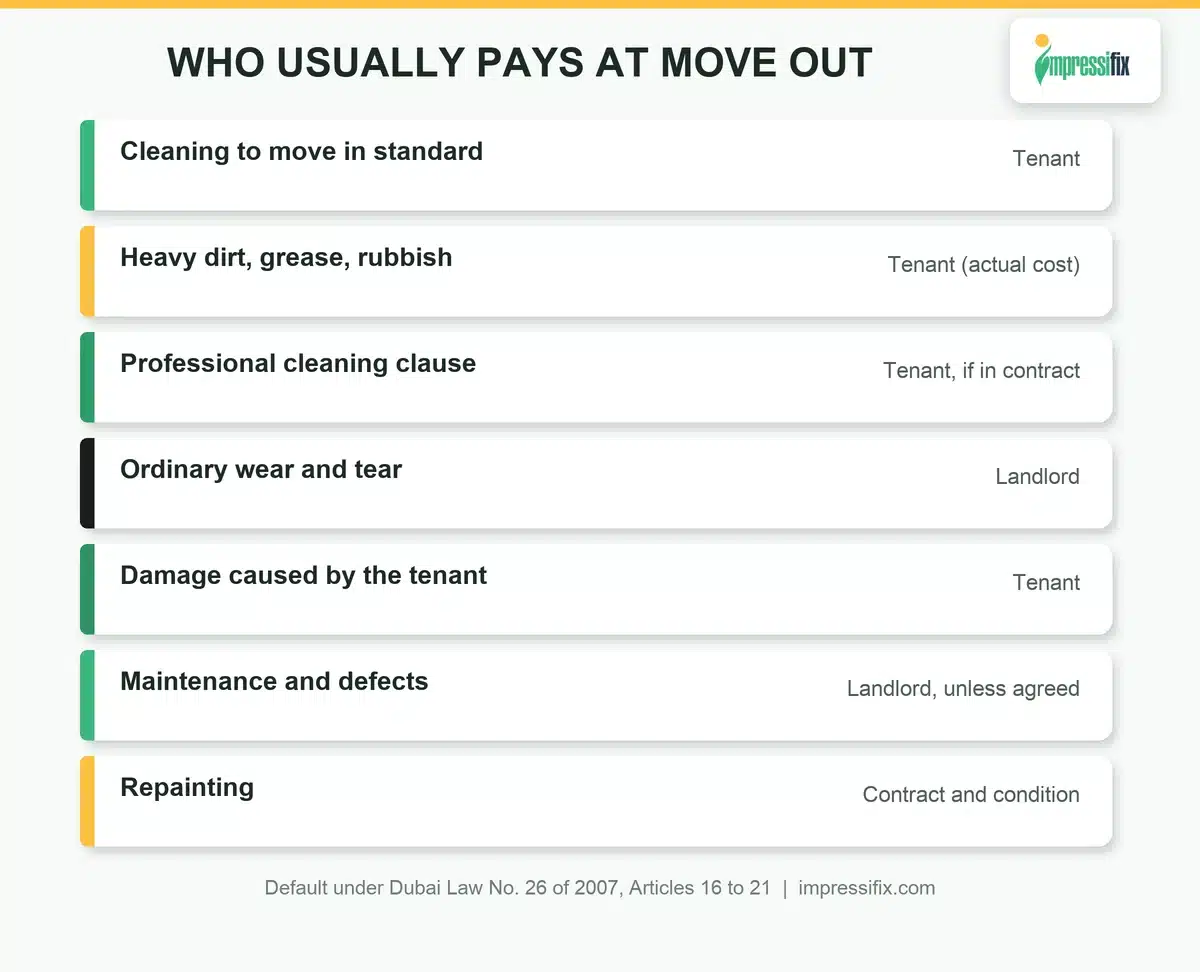
Who usually pays for what at move out
This table summarises the default position under Dubai law. Your contract can change several of these lines, so check it first.
| Cost at move out | Usually paid by | When it changes |
|---|---|---|
| Cleaning to the move in standard | Tenant | If the home is already returned clean, there is nothing to charge |
| Heavy dirt, grease, rubbish left behind | Tenant (can be deducted) | Only the actual, reasonable cost of putting it right |
| A “professional cleaning” clause | Tenant | Applies when it is written in the contract or its addendum |
| Ordinary wear and tear (faded paint, worn fittings) | Landlord | Not the tenant’s cost under Article 21 |
| Damage caused by the tenant | Tenant | Beyond wear and tear, backed by evidence |
| Maintenance and defects | Landlord | Unless the contract shifts minor maintenance to the tenant |
| Repainting | Depends | Contract terms and whether marks go beyond normal wear and tear |
Your tenancy contract decides the details
Most disputes are settled by the wording of the contract rather than the law. In Dubai, the tenancy contract is registered through Ejari with the Dubai Land Department, and landlords often attach an addendum with extra terms. Additional terms must not conflict with the law, but they can still set your move out duties.
Before you book anything, look for these lines in the contract and addendum:
- A professional cleaning clause, which may ask you to return the home professionally cleaned or to show a receipt at handover.
- Painting or “reinstatement” terms, which say whether you repaint or restore walls you changed.
- AC servicing or pest control, which some contracts assign to the tenant.
- The handover process, such as a joint inspection or a notice period before the final check.
If a clause is unclear, ask the landlord or agent in writing before you move out, so the answer is on record. This guide is general information, not legal advice.
Sharjah, Ajman and the other emirates
Each emirate has its own rental law and its own dispute committee, so article numbers from Dubai do not carry over. The practical rule is the same across the UAE: read your attested contract, return the home in the condition you received it, and keep evidence. Tenants in Sharjah can follow our end of tenancy cleaning guide for Sharjah, and tenants in Ajman our move out cleaning guide for Ajman, which covers the Tasdeeq contract.
Clean it yourself, book a clean, or accept a deduction?
If the home needs more than a light clean, a booked clean usually costs less than an argument over a deduction, and a dated receipt closes the cleaning question. These are typical end of tenancy prices from our cleaning price calculator; a fixed price is confirmed before you book.
| Home size | Sharjah and Ajman | Dubai | Ras Al Khaimah, Umm Al Quwain, Fujairah |
|---|---|---|---|
| Studio | AED 250 to 450 | AED 300 to 500 | AED 450 to 600 |
| 1 bedroom | AED 350 to 600 | AED 400 to 650 | AED 500 to 700 |
| 2 to 3 bedrooms | AED 500 to 1,100 | AED 550 to 1,100 | AED 650 to 1,100 |
| Townhouse | AED 700 to 1,100 | AED 800 to 1,300 | AED 800 to 1,300 |
| Villa | AED 1,000 to 1,800 | AED 1,000 to 1,800 | AED 1,000 to 1,800 |
An end of tenancy clean is a deep clean of an empty home, which is why it costs more than a regular visit. Our guide to what is included in a deep clean shows the tasks a handover clean covers.
How to avoid a cleaning dispute at handover
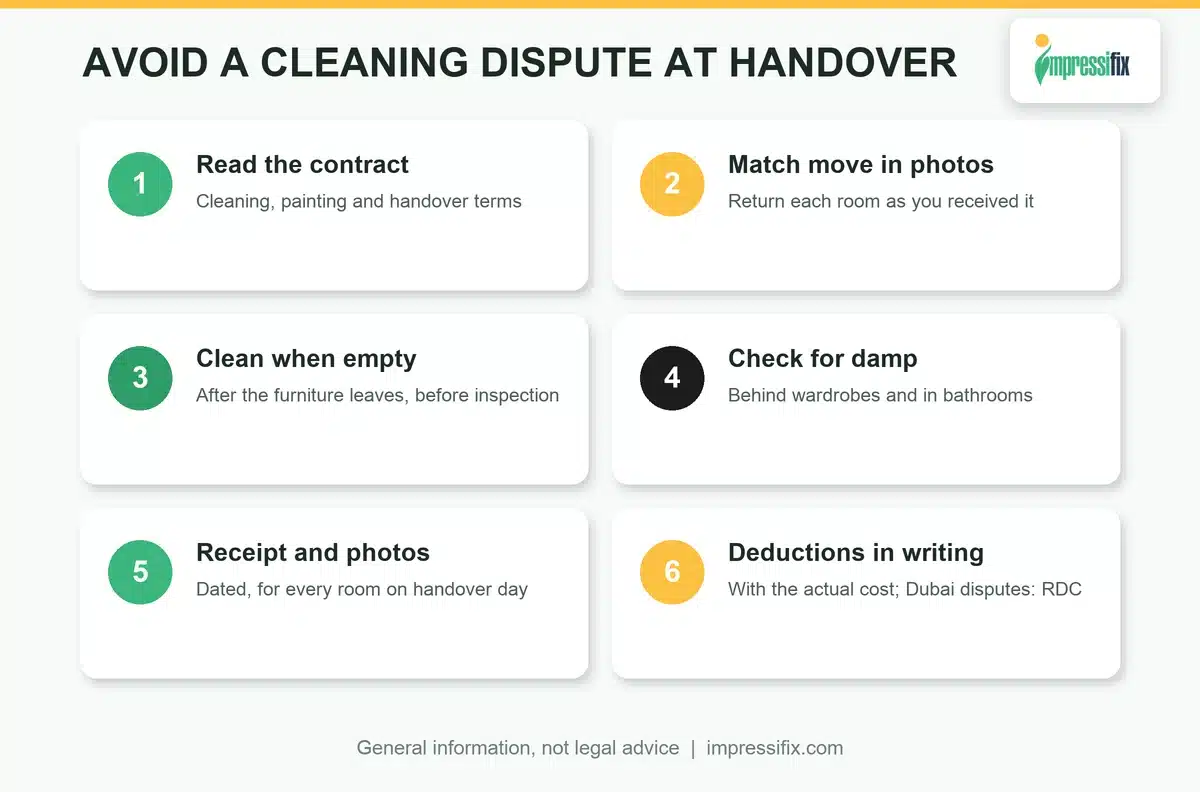
- Read the contract and addendum for cleaning, painting and handover terms.
- Find your move in photos or report and match each room to it. If you are about to move into a new home, our move in cleaning checklist shows what to record on day one.
- Clean after the furniture leaves and before the final inspection, so nothing is marked after the clean.
- Check for damp and mould behind wardrobes and in bathrooms. The EPA’s guide to mould and moisture explains how to clean small areas.
- Keep a dated receipt and photos of every room on handover day.
- Attend the inspection and ask for any deduction in writing, with the actual cost.
- If you cannot agree, Dubai disputes go to the Rental Disputes Center of the Dubai Land Department; other emirates have their own committees.
Frequently asked questions
Who pays for window cleaning, landlord or tenant?
Inside windows, glass doors and sills that you can reach are part of returning the home clean, so they are normally the tenant’s job at move out. The outside glass of apartment towers is cleaned by the building’s management as part of the shared areas, which is not the tenant’s bill. For villas and townhouses, check the contract, and if windows are on the handover list, our end of tenancy cleaning service includes internal windows.
Should you clean your apartment when you move out?
Yes. Dubai’s tenancy law expects you to return the property in the condition you received it, apart from normal wear and tear, and a dirty flat is the easiest deduction for a landlord to justify. Many contracts also ask for a professional clean, so a cleaned home and a dated receipt protect your deposit.
What can landlords take from your deposit?
Under Article 20 of Dubai Law No. (26) of 2007, the deposit is held to ensure maintenance of the property. In practice, deductions should cover the actual cost of damage beyond normal wear and tear, cleaning a home returned dirty, and any cost your contract places on you. Ask for each deduction in writing with the invoice.
Is a security deposit refundable in Dubai property renting?
Yes. The law requires the landlord to refund the deposit, or what remains of it after justified deductions, when the lease ends. If the landlord keeps it without a valid reason, you can file a case with the Rental Disputes Center.
Who pays the service charge in Dubai, landlord or tenant?
Service charges for a building’s shared areas are the owner’s bill in Dubai, so the landlord pays them, not the tenant. Tenants usually pay rent plus their own utilities, such as DEWA and, where it is billed separately, cooling. Check your contract and our Dubai end of tenancy guide for the bills to settle before handover.
Book your clean or get a quote in 60 seconds
Tell us your home size, area and handover date, and we will confirm a fixed price and a vetted team before you commit. You get a dated receipt for your landlord. Our team answers Monday to Saturday, 9:30am to 7pm.