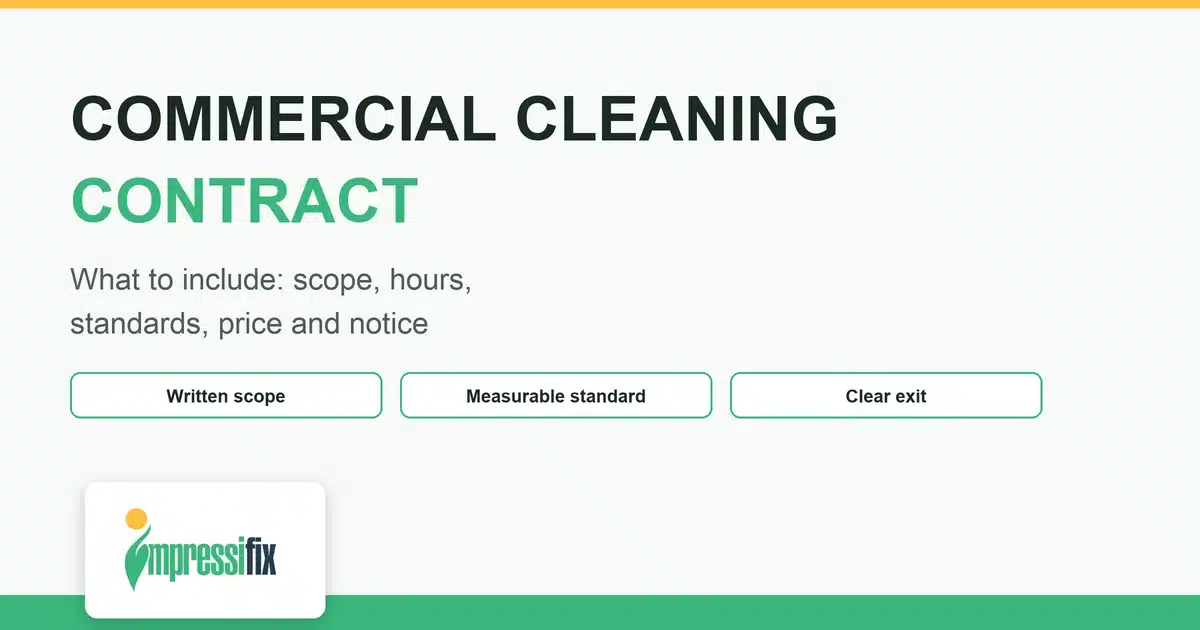
A commercial cleaning contract is the document you go back to every time the pantry is missed, a cleaner is off sick or the invoice changes, so the detail matters more than the headline price. In the UAE that contract also has to deal with local points such as 5% VAT, building access rules and the summer midday break for outdoor work. This guide sets out, clause by clause, what a good contract for office and commercial cleaning should include, the standards to write into it, and the gaps that cause most disputes.
In practice, a good commercial cleaning contract does four jobs: it fixes the scope (what is cleaned, how often and when), sets a standard you can check, names who supplies what, and states the price, notice period and how either side can end the agreement. If any of those four is vague, problems usually follow.
What a commercial cleaning contract is
A commercial cleaning contract is a written service agreement between a business and a cleaning company for regular cleaning of a workplace: offices, clinics, shops, showrooms, schools or the common areas of a building. It usually has two parts. The main agreement covers the legal and commercial terms, and one or more schedules cover the work itself: the task list, the visit times and the quality standard.
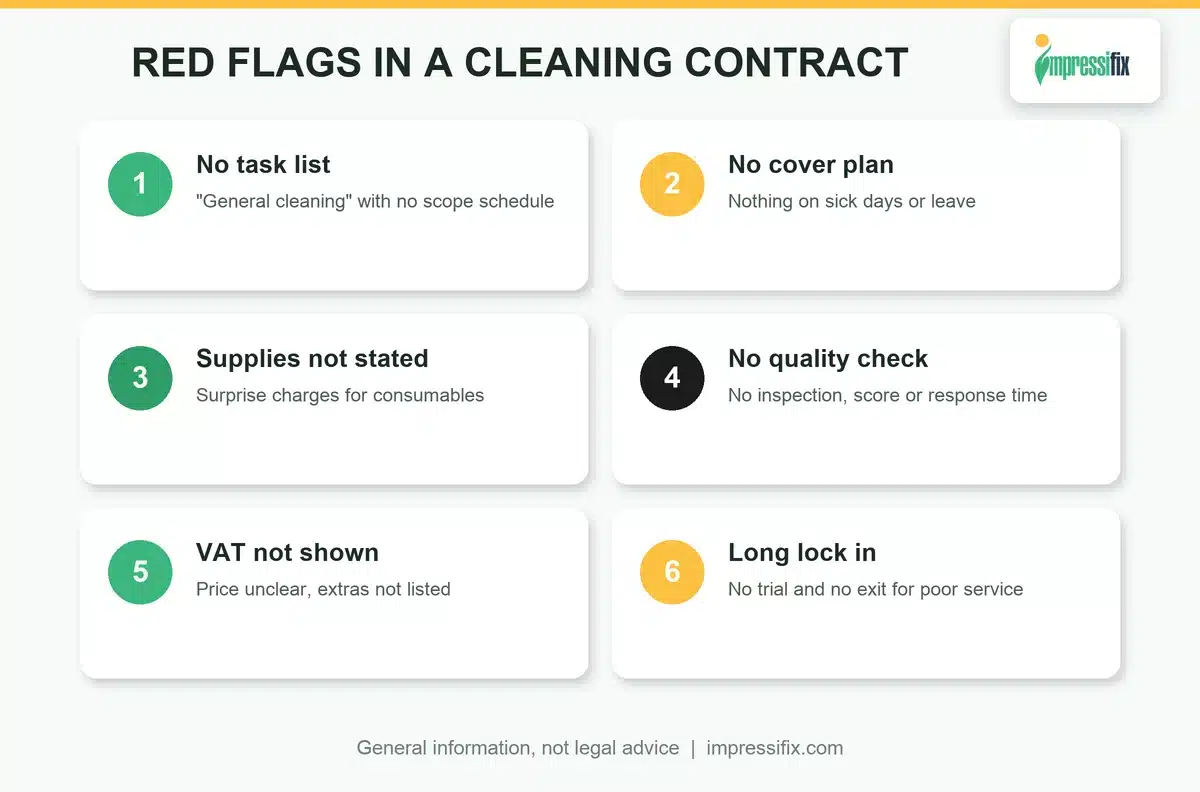
Many contracts also include a service level agreement (SLA). The SLA turns “keep the office clean” into measurable points, for example how often washrooms are checked, how quickly a complaint is fixed and what score an inspection must reach. Before you compare contracts, make sure you are comparing the same scope. Our guide on how to choose an office cleaning company covers the licence, insurance and reference checks to run first.
Want a fixed price for your home?
Tell us your home size and area and a vetted team gets back with an exact quote, usually the same day.
What to include, clause by clause
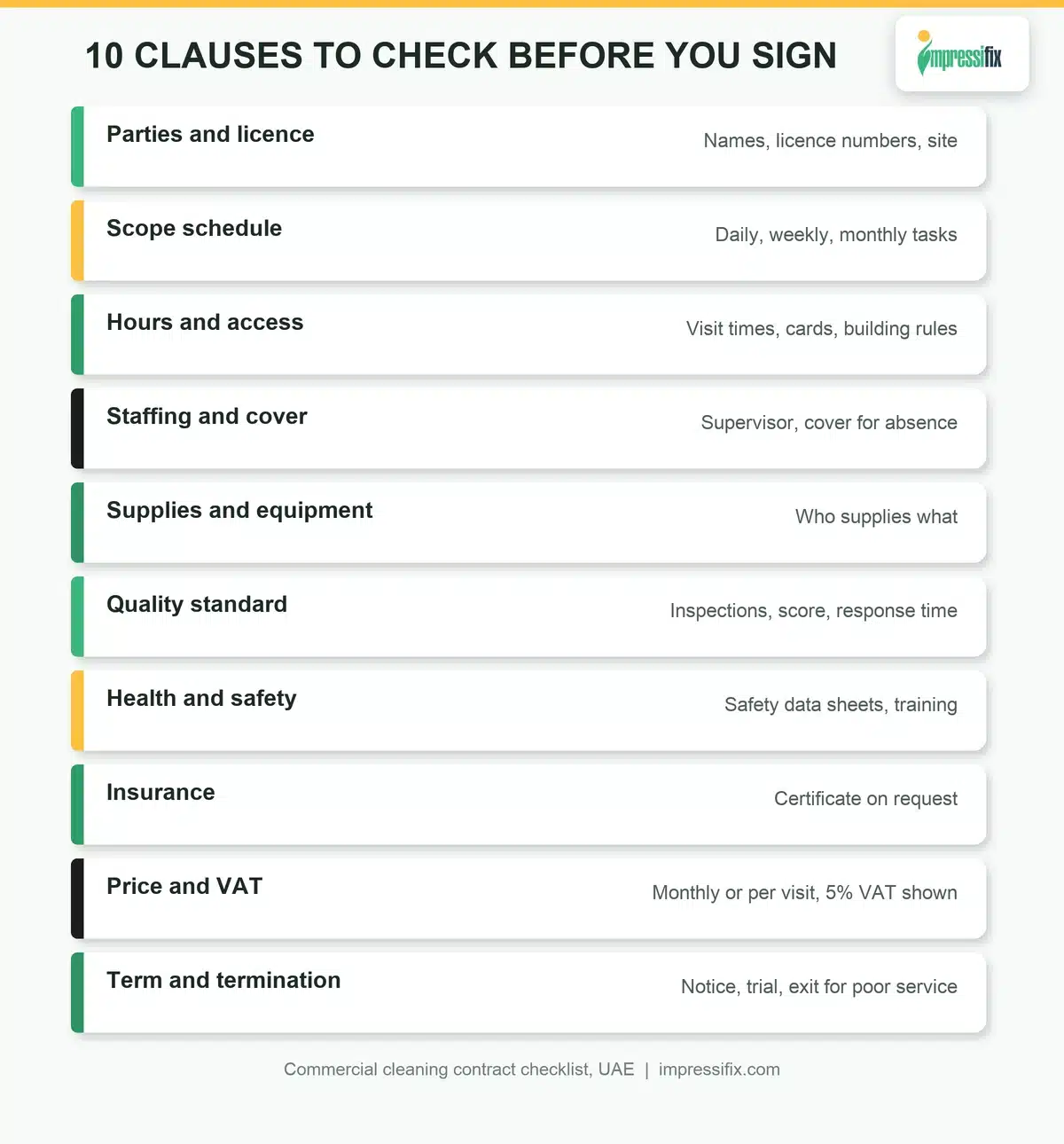
This table lists the clauses most UAE businesses need. Not every site needs every line, but a missing line should be a decision, not an accident.
| Clause | What to write | Why it matters |
|---|---|---|
| Parties and licence | Legal names, trade licence numbers, the site address | The invoice should match the licensed company |
| Scope schedule | Areas and tasks, split into daily, weekly and monthly | “General cleaning” cannot be checked |
| Hours and access | Visit days and times, access cards, building rules | Avoids missed visits and security problems |
| Staffing and cover | Number of cleaners, supervision, cover for absence | Sick days are the most common gap |
| Supplies and equipment | Who supplies consumables, chemicals and machines | A frequent source of surprise charges |
| Quality standard | Inspection method, target score, complaint response time | Gives both sides the same yardstick |
| Health and safety | Safety data sheets, training, protective equipment | Protects staff, cleaners and surfaces |
| Insurance | Type of cover the company holds, certificate on request | Covers damage to your property |
| Price and VAT | Monthly or per visit price, VAT shown, extras price list | The figure you will compare each month |
| Term and termination | Start date, length, notice period, trial period, exit for poor service | Lets you leave if the standard slips |
Scope, frequency and hours
The scope schedule is the heart of the contract. List every area (reception, open office, meeting rooms, pantry, washrooms, stairs, store rooms) and the tasks for each, split by frequency. Our daily, weekly and monthly office cleaning checklist is a ready starting point you can paste into the schedule and edit.
Then fix the timing. Write down the days and hours of each visit, whether cleaning happens before, during or after working hours, and the building’s rules for access cards, lifts and loading bays. If the contract covers outdoor areas, such as car parks, terraces or shop fronts, plan around the UAE midday break: from 15 June to 15 September, outdoor work in direct sun is not allowed between 12:30pm and 3pm, as Gulf News reports on the 2026 midday break.
Periodic work belongs in the scope too. A contract that covers daily cleaning only will not include carpet shampooing, window cleaning at height or a full deep clean unless they are listed with their frequency. If you are unsure where daily cleaning ends, our guide to deep cleaning vs regular cleaning explains the difference.
Standards you can measure
A standard only helps if both sides can check it the same way. The simplest approach is a monthly joint walk round with a short scoring sheet: each area is marked against the scope, and the score is shared with the supervisor. Agree in the contract:
- How quality is checked: who inspects, how often, and the scoring method.
- The target: the minimum score or the number of failed points allowed per month.
- Response times: how quickly a reported problem is put right, and how quickly a missed visit is made up.
- Reporting: one contact person on each side and one channel for complaints.
- Review: a short review after the first month and then at an agreed interval.
Some facilities teams also ask whether a company follows a recognised management standard, such as ISSA’s Cleaning Industry Management Standard (CIMS). It is not a legal requirement, but it gives you a useful list of what a well run cleaning operation documents.
Staff, supplies and safety
Write down how many cleaners will attend, who supervises them and what happens when a cleaner is absent. Ask that new staff are introduced before their first visit, especially where there are confidential areas or keys.
The contract should say clearly who supplies consumables (soap, tissue, bin liners), cleaning chemicals and equipment such as vacuum cleaners and floor machines. There is no single right answer, but if it is not written down, it will be argued about later. For chemicals, ask for safety data sheets and labelled containers; the US Occupational Safety and Health Administration explains why in its hazard communication guidance.
Finally, ask what insurance the company holds for damage to your property and for its own staff, and ask for the certificate. Note the expiry date and request the renewed certificate each year.
Price, VAT and changes
Office cleaning is usually priced either by the hour or as a fixed monthly fee for an agreed schedule. As a reference, hourly cleaning on our cleaning price calculator typically costs AED 30 to 45 per hour in Sharjah and Ajman and AED 35 to 50 per hour in Dubai. A monthly price is quoted by scope: floor area, frequency, hours and the tasks in your schedule. Our comparison of cleaning services prices per hour shows how the rates differ by emirate.
Whatever the model, the contract should state:
- The price per month or per visit, and whether it includes VAT. UAE VAT is 5%, and the Federal Tax Authority explains how it applies to services.
- A price list or method for extras, such as one off deep cleans, event clean ups or extra hours.
- How the price changes if the scope changes, for example when you take another floor.
- Invoice frequency and the payment terms you have agreed.
If you are moving into a newly fitted office, keep the first clean out of the regular contract. Construction dust needs an after builders clean before the daily schedule starts, or it spreads through vents and tracks for weeks.
Term, notice and ending the contract
Most commercial cleaning contracts run for a fixed period with a notice period to end or renew, and many start with a trial month. The length that suits you depends on the size of the site and how settled your needs are. Whatever you agree, check that the contract includes:
- A start date and term, and what happens at the end (renewal or expiry).
- A notice period that works for you, stated in days.
- A trial period with a review before the full term applies.
- An exit for poor service, linked to the quality standard and a written warning.
- Return of keys and access cards when the contract ends.
- Confidentiality for documents, screens and restricted rooms.
- Dispute resolution: who to escalate to first, and the governing law and courts.
Check the company’s trade licence through the UAE government’s licence inquiry services before you sign, and have a lawyer review the agreement if the value or term is significant. This guide is general information, not legal advice.
Frequently asked questions
What to include in a cleaning contract?
A cleaning contract should include the parties and their licences, a scope schedule of areas and tasks by frequency, visit days and hours, staffing and cover, who supplies consumables and equipment, and a measurable quality standard. It should also state insurance, the price with VAT, how extras are charged, the term, notice period and how either side can end it. Our office cleaning checklist is a good base for the scope schedule.
What is a commercial cleaning contract?
It is a written service agreement between a business and a cleaning company for regular cleaning of a workplace, such as an office, clinic, shop or building common areas. The main agreement covers the commercial and legal terms, and schedules set out the tasks, visit times and the standard expected. Many include a service level agreement with response times and inspection scores.
Can I pull out of a cleaning contract?
Usually yes, on the terms the contract sets. Most commercial cleaning contracts run for a fixed period with a notice period to end or renew, many start with a trial month, and a good contract adds an exit for poor service linked to the quality standard and a written warning. Before you commit, our guide on choosing an office cleaning company lists the questions to ask about notice and trials.
What does commercial cleaning consist of?
Commercial cleaning usually covers desks and surfaces, bins, floors, pantries, washrooms and high touch points such as door handles and lift buttons, on a daily or weekly schedule. Periodic tasks such as carpet shampooing, window cleaning at height and deep cleaning are only included when the contract lists them. Exactly what is included depends on the scope schedule you agree.
How much does it cost to have cleaning services provided in Dubai?
On our cleaning price calculator, hourly cleaning typically costs AED 35 to 50 in Dubai and AED 30 to 45 in Sharjah and Ajman. Commercial contracts are priced either by the hour or as a fixed monthly fee for an agreed scope, which depends on floor area, frequency, hours and tasks. Ask for the monthly price in writing against your checklist, with VAT shown.
Book your clean or get a quote in 60 seconds
Send us your office size, the areas to clean, your preferred days and hours and your checklist, and we will propose a schedule with a fixed price before you commit. Our team answers Monday to Saturday, 9:30am to 7pm.