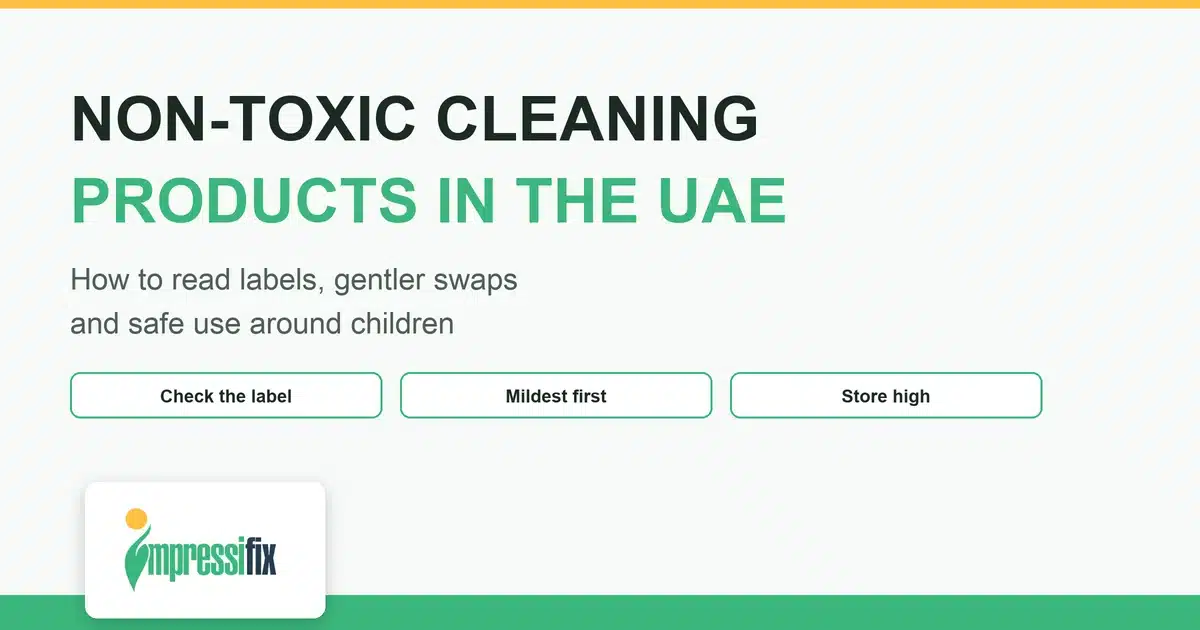
Non toxic cleaning products are on every shelf in the UAE now, from Carrefour aisles to delivery apps, but the labels do not always mean what parents hope. A US study of poison centre calls found that household cleaning products are the second most common cause of unintentional poisoning in children under six, with over 1.3 million child exposures reported between 2000 and 2015. This guide explains how to read a label, which simple swaps suit UAE homes, and how to keep any product safe around children. If you would rather hand the work over, our regular home cleaning service can follow your product preferences.
For most families, the safest approach is less about finding a perfect bottle and more about three habits: choose products with an independent safety label rather than a “natural” claim, use the mildest product that does the job (often soap and water), and store and use every cleaner as the label directs, out of reach of children.
What “non toxic” on a label really means
Words such as natural, green, eco and non toxic are claims made by the brand. They are not the same as an independent check. The American Academy of Pediatrics’ HealthyChildren.org warns that a product labelled “green” or “natural” may still contain ingredients that cause health problems, and points parents to third party logos instead.
Labels the AAP names include Safer Choice, Green Seal Certified, Made Safe and EWG Verified. Under the US EPA’s Safer Choice programme, every chemical ingredient is reviewed regardless of its percentage, and a separate fragrance free label exists for people who want no added scent. Some imported products sold in the UAE carry these marks, so they are worth looking for on the back of the bottle.
Why children are more sensitive
- They breathe faster. Children take in more air for their body weight than adults, so fumes and sprays reach them in higher doses.
- They live on the floor. Crawling on tiles and rugs, then putting hands and toys in mouths, means floor cleaner residue matters more than worktop spray.
- Closed homes. For much of the year UAE homes are kept shut with the AC running, so scents and vapours linger longer than in a home with open windows.
Want a fixed price for your home?
Tell us your home size and area and a vetted team gets back with an exact quote, usually the same day.
How to choose safer cleaning products in the UAE
Use this short checklist in the shop or on a delivery app before you buy.
- Look for an independent logo, such as Safer Choice or Green Seal, rather than a front label claim.
- Read the full ingredient list. If a brand will not list its ingredients, choose one that does.
- Prefer fragrance free. Added fragrance can irritate sensitive skin and airways, and it does nothing for cleaning.
- Check the warning symbols. A corrosive or “danger” symbol means the product needs gloves, ventilation and locked storage, whatever the front label says.
- Buy the mildest product for the job. A pH neutral floor cleaner and a dish soap cover most daily cleaning; strong products are for specific problems.
- Avoid sprays near children. A cloth dampened with the product puts less into the air than a spray.
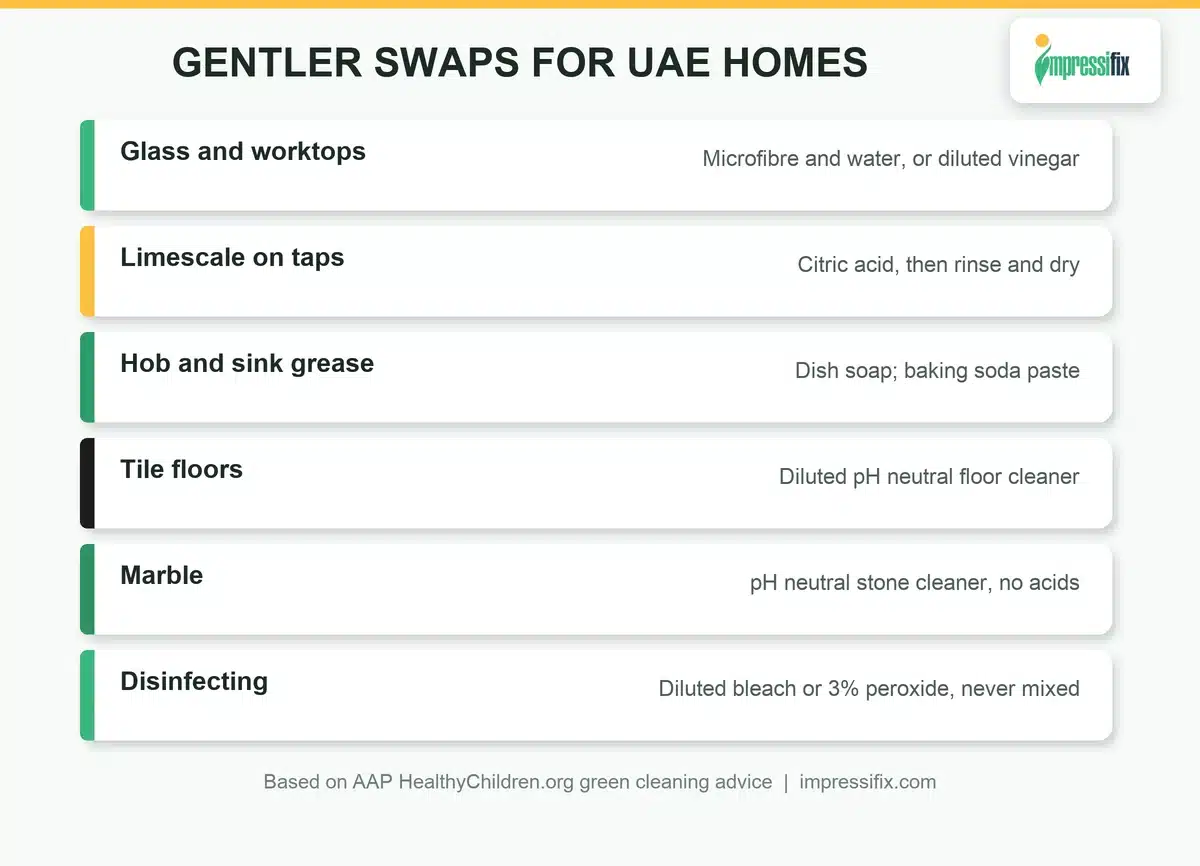
Gentler swaps for common jobs in UAE homes
Many everyday jobs need far less than a strong chemical. These swaps follow the AAP’s green cleaning advice and suit the hard water, sand and stone floors found in most UAE homes.
| Job | Gentler option | Watch out for |
|---|---|---|
| Glass, mirrors, worktops | Microfibre cloth with water, or 1 part vinegar to 2 parts water | Vinegar can damage natural stone and waxed wood |
| Limescale on taps and shower glass | Citric acid solution, then rinse and dry | Keep acids off marble and natural stone |
| Grease on the hob and sink | Warm water and dish soap; baking soda paste for build up | Avoid caustic oven sprays near children |
| Tile and porcelain floors | A diluted pH neutral floor cleaner, then let it dry | Keep children off wet floors |
| Marble floors and counters | A pH neutral stone cleaner only | No vinegar, lemon or citric acid |
| Disinfecting when someone is sick | Properly diluted household bleach or 3% hydrogen peroxide, as the AAP notes | Never mix bleach with other cleaners |
Hard water is the main reason UAE bathrooms need an acid at all. Our guide to bathroom limescale removal in the UAE explains how to keep build up low so you need it less often. For fine sand, a damp microfibre cloth beats any spray, as our tips to reduce dust at home in the UAE show.
Products to treat with extra care
Some products are harsh by design and are best kept for specific jobs, used with gloves and stored high up.
- Drain cleaners and oven cleaners. Many are strongly alkaline, and the US study found alkali based cleaners caused the most serious injuries among child exposures.
- Toilet bowl and descaling acids. Effective on heavy scale, but corrosive.
- Bleach. Useful when diluted, but the Washington State Department of Health warns that mixing bleach with ammonia or acids such as vinegar releases toxic gases.
- Laundry and dishwasher pods. Small, bright and easy for a toddler to bite: keep them in a closed cupboard.
Grease heavy kitchens tempt people towards the strongest spray. Our kitchen deep cleaning guide shows the order of work that lets milder products do more of the job.
Using and storing cleaners safely with children at home
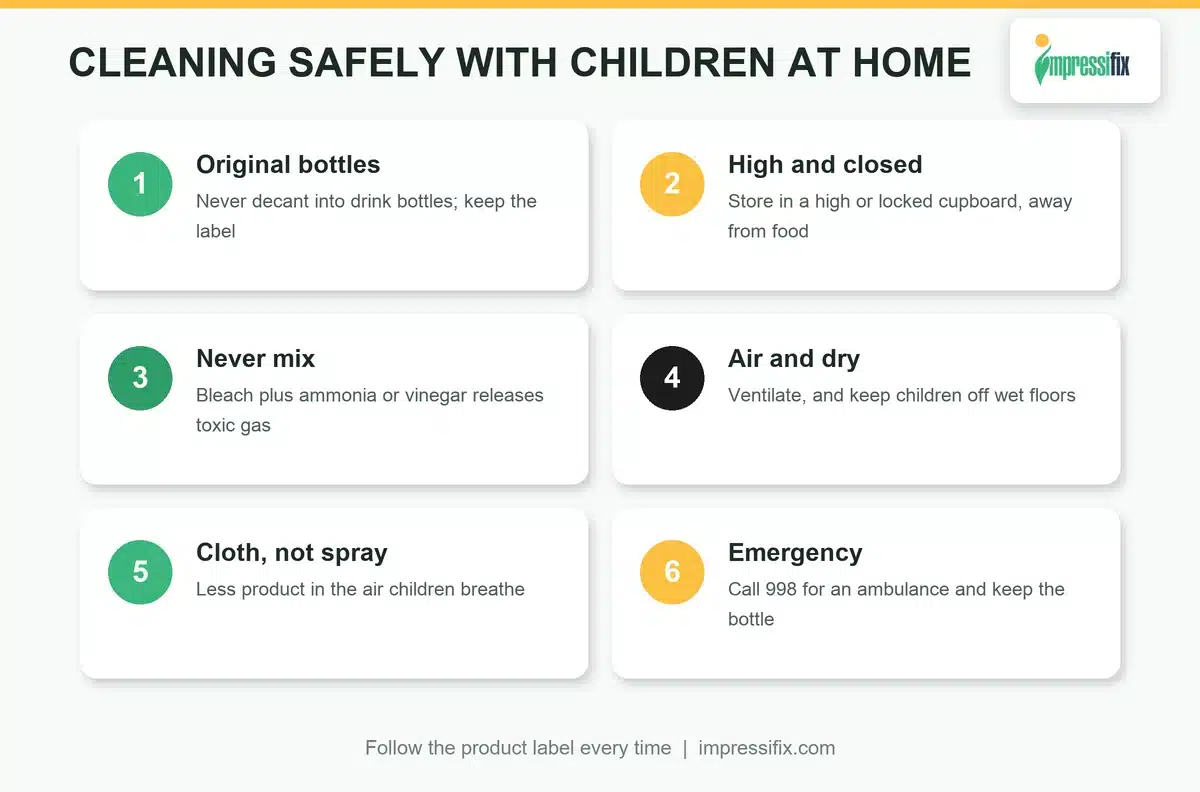
- Keep cleaning products in their original bottles. Never decant into water or juice bottles; the label carries the first aid advice.
- Store high and closed. A locked or high cupboard, away from food, and away from pets too, as our pet friendly home cleaning guide explains.
- Air the room. Open a window or run the extractor while you clean, then let floors dry before children walk on them.
- Clean while children are out or asleep, or in another room, so they are not near wet surfaces or fumes.
- In an emergency, call 998 for an ambulance in the UAE, and keep the bottle to show the paramedics.
A simple routine also means fewer products. Our home cleaning schedule for busy families spreads the work so nothing builds up enough to need a harsh cleaner, and our small apartment cleaning tips cover the same idea for compact flats.
Booking a cleaner when you prefer gentler products
If you book a professional clean, tell us about children, allergies, pets and any products you want used or avoided when you book. If you would like the team to use your own products, set them out with the other supplies, and we confirm what is possible for your visit. Extras such as ironing, changing linen or inside the fridge can be added at an extra cost, confirmed at booking. Our guide to booking a home cleaner in the UAE covers the rest of the process.
Frequently asked questions
What cleaning products are actually non-toxic?
No cleaner is completely harmless if it is swallowed or splashed in the eyes, so “non toxic” is best read as “lower risk when used as directed”. Products with an independent label such as Safer Choice or Green Seal have had their ingredients checked, and simple options like dish soap, water and baking soda handle most daily jobs. The AAP’s green cleaning guide lists the labels and safer disinfecting ingredients.
How do you know if a cleaning product is eco-friendly?
Look for a third party certification on the bottle rather than words like natural or green on the front. A full ingredient list, fragrance free formulas and refill or concentrate packs are also good signs. The EPA explains what its Safer Choice label checks, including every ingredient and the packaging.
What are the top 10 most toxic cleaning products to avoid?
Rather than a fixed top 10, it helps to know the types that cause the most harm: drain cleaners, oven cleaners, toilet bowl acids, concentrated bleach, ammonia based glass sprays, rust removers and laundry or dishwasher pods. Any two cleaners mixed together can also be dangerous, especially bleach with ammonia or vinegar. If you keep any of these, store them high and locked, and for heavy limescale see our limescale removal guide for gentler routines.
What cleaning products have no chemicals?
Everything, including water, is a chemical, so a “chemical free” claim is marketing rather than fact. What matters is whether the ingredients are low risk at the strength you use them. Water with a microfibre cloth, mild dish soap, baking soda and diluted vinegar on suitable surfaces are as close as you get.
What are some natural, toxic-free cleaning products available?
Kitchen staples sold in any UAE supermarket do a lot: baking soda as a gentle scrub, white vinegar for glass and non stone surfaces, citric acid for limescale and plain dish soap for grease. For ready made products, choose ones with an independent safety label and a full ingredient list. Whatever you use, follow the label, ventilate the room and keep it away from children, as our pet friendly cleaning guide also advises for pets.
Book your clean or get a quote in 60 seconds
Tell us your home size, area, and any children, allergies or product preferences, and we will confirm a fixed price and a vetted team before you commit. Our team answers Monday to Saturday, 9:30am to 7pm.