
Dust in the UAE is not a once a year problem. A long term study of four UAE weather stations found that dust storms peak in winter, most dust events fall in March and April, and around 90 percent of dust episodes blow in from the southwest, according to research by Basha and colleagues (2019). Add sealed homes with the AC running most of the year, and fine sand ends up on every ledge, grille and floor. This guide explains how to reduce dust at home in the UAE: where it gets in, what to do about AC vents and filters, a cleaning routine that removes dust rather than moving it around, and when a professional clean makes sense.
In practice, the homes that stay least dusty do four things well: they keep sand out at the door and windows, they keep AC filters and vent grilles clean, they remove dust with damp cloths and a good vacuum instead of dry dusters, and they follow a weekly routine with a deeper reset every few months.
Why UAE homes get so dusty
Three things combine here. First, the air outside carries fine desert sand for much of the year, not only on storm days. Second, apartments and villas are closed up and cooled for months at a time, so whatever gets in keeps circulating through the AC. Third, fine sand is light enough to pass through gaps around windows, balcony doors and entrance doors, and it arrives on shoes and shopping bags every day.
Indoor air matters because we spend so much time in it. The US Environmental Protection Agency notes that people spend approximately 90 percent of their time indoors, and that some pollutants are often two to five times more concentrated inside than outside. In a sealed, air conditioned home, dust control is part of keeping that air comfortable.
Want a fixed price for your home?
Tell us your home size and area and a vetted team gets back with an exact quote, usually the same day.
Where dust gets in, and what actually helps
Use this table to find the main entry points in your home and the fix for each. Most cost nothing beyond a little routine.
| Dust source | What you notice | What helps | How often |
|---|---|---|---|
| Windows and balcony doors | Sand lines on sills and tracks, grit on balcony floors | Keep closed on dusty days, check rubber seals, vacuum tracks before wiping | Tracks weekly, seals once a season |
| Entrance and shoes | Grit in the hallway and on rugs | A good doormat inside and out, shoes off at the door, shoe cabinet with a closed front | Shake mats out every few days |
| AC filters | Grey layer on the filter, weaker airflow, dust returning soon after cleaning | Wash or replace filters following the unit instructions | Check monthly, more often in dusty months |
| AC vent grilles | Dark streaks on the ceiling around vents | Vacuum with a brush head, then wipe with a damp microfibre cloth | Every two to four weeks |
| Soft furnishings | Dusty smell from rugs, curtains and cushions | Vacuum slowly, wash cushion covers and bedding, shake rugs outside | Bedding weekly, curtains every few months |
| Clutter on open shelves | Dust on ornaments, books and the tops of wardrobes | Fewer open surfaces, closed storage, damp dust top to bottom | Weekly |
AC vents and filters: the biggest win
Your AC moves the air in your home all day, so its filters decide whether dust is trapped or blown back into the room. DEWA’s air conditioning tips advise cleaning AC filters at regular intervals and keeping doors and windows fully closed while the AC is on, which also helps the system cool efficiently.
Filters you can clean yourself
Split units usually have washable mesh filters behind the front panel. Switch the unit off, slide the filters out, vacuum the loose dust and rinse them with lukewarm water. Let them dry fully before refitting. If your building has central or ducted AC, the filter is often in a return grille in the ceiling; check your tenancy or building rules first, because some buildings include filter changes in their maintenance service.
Vent grilles and ceiling streaks
The dark marks around supply vents are fine dust carried by the airflow. Vacuum the grille with a soft brush attachment first, then wipe with a damp microfibre cloth. Wiping first only smears it. Cleaning the fronts of vents is part of a deep clean, which our deep cleaning guide covers in detail.
When to call an AC technician
If dust reappears within a day or two of cleaning, rooms cool unevenly or the vents smell musty, the ducts or coils may need servicing. That is a job for an AC maintenance company or your building’s facilities team, not a cleaner, so raise it with your landlord or building management.

How to reduce dust at home: clean so it leaves, not moves
Dust control is mostly about technique. The same hour of cleaning can either lift dust out of the home or just push it into the air for it to settle again an hour later.
- Work top to bottom. Start with the tops of wardrobes, shelves and light fittings, then furniture, and finish with floors so falling dust is collected last.
- Damp dust, do not dry dust. A lightly damp microfibre cloth holds fine sand. Feather dusters and dry cloths mostly move it around.
- Vacuum before you mop. Mopping a sandy floor drags grit across tiles and marble. Vacuum edges and corners slowly, then mop.
- Use a vacuum with a good filter. The EPA explains that a HEPA filter can theoretically remove at least 99.97 percent of airborne particles of 0.3 microns, so a vacuum or air purifier with a true HEPA filter releases far less fine dust back into the room.
- Do not forget the hidden ledges. Skirting boards, door frames, window tracks, curtain rails and the backs of TVs collect dust quickly.
On dusty and stormy days
When the National Centre of Meteorology issues a dust alert, its advice for the public is to avoid direct exposure and to close doors and windows to stop dust from entering buildings, as reported by Aletihad. Keep balcony doors shut, bring in cushions and laundry from the balcony, and leave the big clean until the dust has settled, otherwise you clean twice.
Once the weather clears, start with balconies and window tracks, then AC filters, then inside surfaces and floors. Heavy sand on balconies is best swept or vacuumed before it is washed, so it does not turn into mud in the drains.
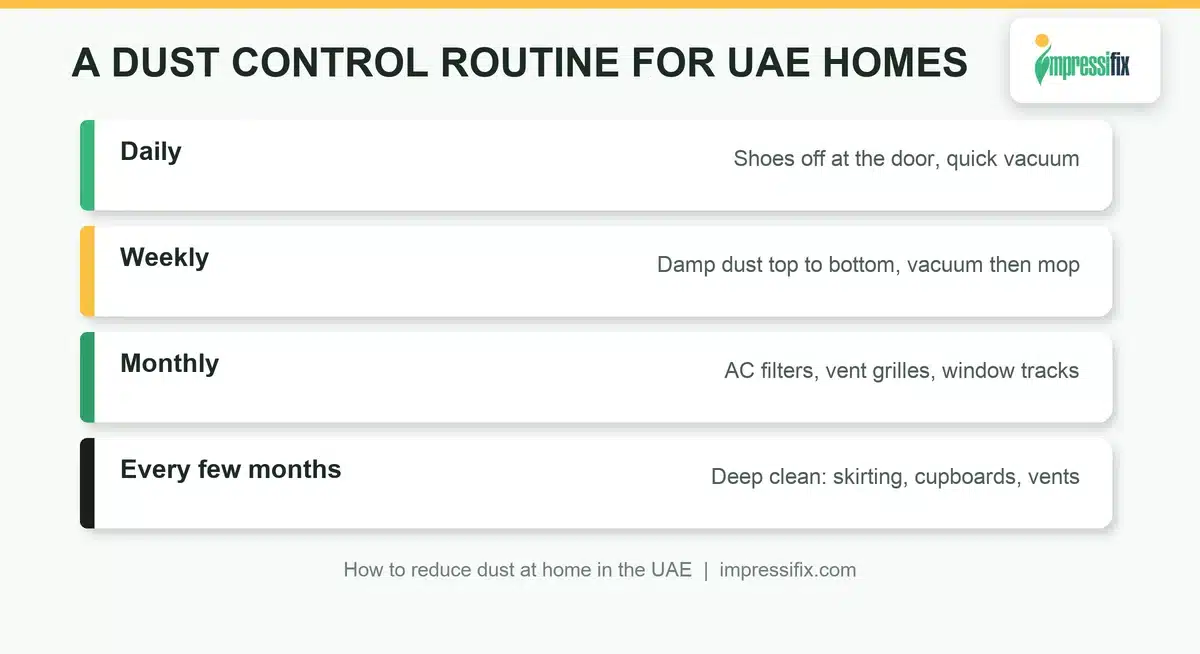
A dust control routine for UAE homes
A simple rhythm keeps dust under control without taking over your week:
- Daily: shoes off at the door, a quick vacuum of the hallway and the busiest room.
- Weekly: damp dust every room top to bottom, vacuum then mop all floors, wash bedding, wipe window sills.
- Monthly: check and clean AC filters, vacuum and wipe vent grilles, clean window tracks and balcony doors.
- Every few months: a deep clean that reaches skirting, door frames, inside cupboards, vent fronts and the corners weekly cleaning skims.
The weekly part is where a regular cleaning visit takes the load off. Our regular cleaning service guide explains how many hours a typical apartment needs and whether weekly or fortnightly suits your household. For the reset every few months, a deep home cleaning covers kitchen degreasing, bathroom descaling and the high and low surfaces where dust builds up.
What professional help typically costs
If you would rather hand the routine over, these are the typical ranges from our cleaning price calculator and location pages. Your exact price is always fixed before the visit.
| Service | Sharjah | Dubai | Best for |
|---|---|---|---|
| Regular cleaning, per hour | Typically AED 30 to 45 | Typically AED 35 to 50 | Weekly damp dusting, vacuuming and mopping |
| Deep clean, 1 bedroom | Typically AED 400 to 550 | Typically AED 450 to 650 | Vents, skirting, inside cupboards, kitchen and bathrooms |
| Deep clean, villa | Typically AED 700 to 1,500 | Typically AED 900 to 1,800 | A full reset after a dusty season |
Most visits have a two to four hour minimum. You can see rates and areas on our Sharjah cleaning services and Dubai cleaning services pages. Moving into a home that has been empty for a while? Our move in cleaning checklist includes AC grilles, window tracks and the dust the last occupant left behind.
Frequently asked questions
How do I reduce dust in my house in the UAE?
Keep doors and windows closed on dusty days, use doormats and take shoes off at the entrance, and clean AC filters and vent grilles regularly. Clean top to bottom with damp microfibre cloths and vacuum before you mop. A weekly regular cleaning visit keeps that routine going when you are busy.
Why is my house so dusty even with the windows closed?
Fine sand still enters through gaps around doors and window seals and on shoes, and the AC keeps it circulating if the filters are clogged. Soft furnishings and open shelves also hold dust and release it when disturbed. Checking seals, cleaning filters and damp dusting usually make a visible difference within a week or two.
How often should I clean AC filters in the UAE?
Check them monthly and clean them whenever you see a grey layer, which can be more often in dusty months. DEWA advises cleaning AC filters at regular intervals, and clean filters also help the system cool efficiently. Follow your unit’s instructions and your building’s rules for central systems.
Do air purifiers help with dust?
An air purifier with a true HEPA filter can capture fine airborne dust, and the EPA notes that HEPA filters can theoretically remove at least 99.97 percent of particles of 0.3 microns. It works best alongside regular cleaning, because dust that has already settled on floors and furniture still needs to be removed.
What is the best way to remove dust from a home?
Work from the highest surfaces down, use a lightly damp microfibre cloth instead of a dry duster, and finish with a slow vacuum followed by mopping. Do the hidden ledges such as skirting, door frames and window tracks every few weeks. A deep clean every few months resets the places weekly cleaning misses.
Book your clean or get a quote in 60 seconds
Tell us your home size, emirate and whether you want a weekly routine or a full dust reset, and we will confirm a fixed price and a vetted team before you commit.