
When a sandstorm passes, the sky clears long before your home does. Fine sand sits on balcony floors, packs into window tracks, coats the AC filters and settles on every surface inside within hours. The scale of the problem is global: the World Health Organization estimates that about 330 million people are exposed to wind blown dust every day. This guide to cleaning after a sandstorm in the UAE gives you a safe recovery order, from the balcony to the bedroom, plus what to leave to specialists and when a professional clean is worth booking.
In short, cleaning after a sandstorm works best from the outside in. Wait for the all clear, clear the balcony and window tracks dry, then wash the AC filters before you run the air at full power. Only then dust indoors from top to bottom with damp cloths, vacuum before you mop, and wash fabrics last.
Before you start: wait for the all clear
The urge is to start straight away, but cleaning while dust is still in the air means doing the job twice. Check the latest alerts from the National Centre of Meteorology and wait until the dust warning has ended and visibility is back to normal before you open doors and windows.
During dusty weather, UAE authorities consistently advise keeping doors and windows closed. Dubai Municipality’s dust storm tips also asked residents to clear tools and belongings from balconies and secure outdoor furniture, which also makes the clean up much easier afterwards.
Protect yourself while you work, too. The American Thoracic Society notes that children, older adults and people with chronic lung disease are at higher risk from dust exposure, and that simple cloth barriers such as bandanas do not filter out small particles, while a properly fitted N95 mask does. If someone at home has asthma, let another person do the dusty outdoor work.
Want a fixed price for your home?
Tell us your home size and area and a vetted team gets back with an exact quote, usually the same day.
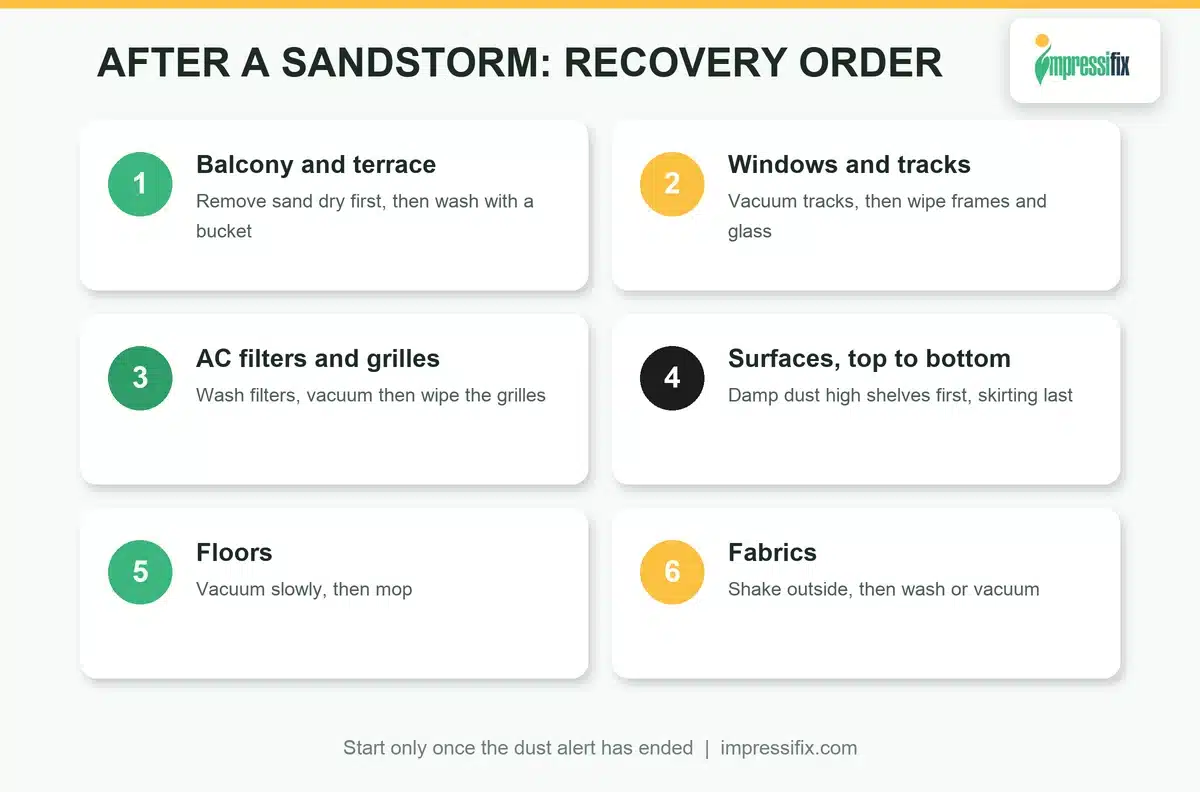
Cleaning after a sandstorm: the recovery order
Order matters more than effort. Each step stops sand from being carried back into rooms you have already cleaned.
| Step | Area | What to do | Why this order |
|---|---|---|---|
| 1 | Balcony and terrace | Sweep or vacuum loose sand dry, then wash | Stops sand being walked indoors |
| 2 | Windows, doors and tracks | Vacuum tracks, then wipe frames and glass | Tracks hold the heaviest sand lines |
| 3 | AC filters and vent grilles | Wash filters, vacuum then wipe grilles | A dusty filter blows sand back into rooms |
| 4 | Surfaces, top to bottom | Damp dust high shelves first, floors last | Falling dust is collected at the end |
| 5 | Floors | Vacuum slowly, then mop | Mopping grit scratches tiles and marble |
| 6 | Fabrics | Shake outside, wash or vacuum | Curtains and cushions hold fine dust |
Balconies and terraces
Balconies take the biggest hit, and they are where most of the sand that ends up indoors comes from. Treat them as the first job.
- Remove sand dry first. Sweep or vacuum heavy sand before you use any water. Wet sand turns to mud, sticks to tiles and can block the drain.
- Check the drain. Clear sand from the balcony drain cover by hand before washing, so water runs away freely.
- Wash with a bucket, not a hose. In apartment towers, water running off a balcony drips onto the units below. Use a mop and bucket and follow your building’s rules.
- Furniture and cushions. Wipe chairs and tables with a damp cloth, then shake cushions and mats well away from the door before bringing them back inside.
- Plants. Rinse leaves gently so they can breathe again, and top up pots that lost soil in the wind.
Windows, doors and tracks
Sliding door and window tracks fill with a fine line of sand after every storm. Vacuum the tracks with a crevice tool first, then wipe them with a damp cloth. Wiping first only pushes wet sand into the corners.
Clean inside glass and frames next, and check rubber seals for gaps where sand got in, because those are the spots to watch in the next storm. Only clean outside glass that you can reach safely from the floor or balcony. Never lean out or stand on furniture; in towers, external windows are usually cleaned by the building’s facade team.
AC filters and vent grilles after a storm
Your AC kept running through the storm, so its filters have done a lot of work. Clean them before you run the system hard again.
- Split units: switch the unit off, slide out the mesh filters, vacuum off loose dust and rinse them in lukewarm water. Let them dry fully before refitting.
- Vent grilles: vacuum with a soft brush first, then wipe with a damp microfibre cloth. Dark marks around the vents are dust carried by the airflow.
- Central or ducted AC: check your building rules, because filter changes are often handled by the facilities team.
If dust keeps blowing out after the filters are clean, or the outdoor unit looks clogged, that is a job for an AC maintenance company or your landlord, not a cleaner. Our guide to reducing dust at home in the UAE covers the monthly filter routine that keeps the next storm easier.
Indoors: surfaces, floors and fabrics
Inside, the goal is to lift sand out of the home rather than move it around. Work in this order in each room.
- Top to bottom. Start with wardrobe tops, shelves and light fittings, then furniture, and finish with skirting.
- Damp, not dry. A lightly damp microfibre cloth holds fine sand. Feather dusters push it back into the air.
- Vacuum, then mop. Vacuum edges and under furniture slowly. A vacuum with a true HEPA filter releases far less fine dust back into the room.
- Kitchen. Wipe worktops and the hob, and rinse anything that was left out uncovered, such as fruit bowls and dish racks.
- Fabrics last. Wash bedding and cushion covers, vacuum sofas and rugs, and take curtains down for washing if they hold a dusty smell.
Bathrooms often need attention too, because sand comes in through extractor grilles and settles on wet surfaces. If hard water and sand combine into a gritty film, our bathroom limescale removal guide explains safe methods by surface.
What a home clean covers, and what it does not
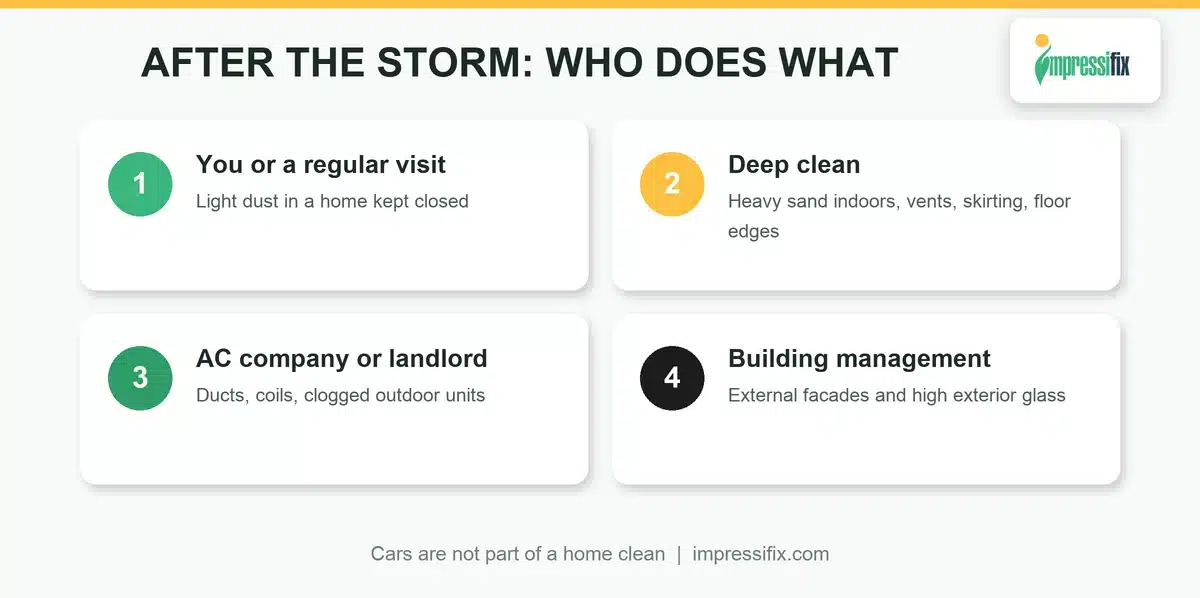
A light dusting after a short storm is usually a job you can do yourself in an afternoon. After a heavy storm, or if you were away and the sand has sat for days, a professional clean saves a lot of time. These are the typical Sharjah ranges from our cleaning price calculator; your exact price is fixed before you book.
| After the storm | Best option | Typical price in Sharjah |
|---|---|---|
| Light dust, home kept closed | Do it yourself, or a regular visit | AED 30 to 45 per hour, 2 to 4 hours for most apartments |
| Heavy sand in a 1 to 3 bedroom apartment | Deep clean | Typically AED 400 to 800 |
| Heavy sand in a villa or townhouse | Deep clean | Typically AED 500 to 900 (townhouse) or AED 700 to 1,500 (villa) |
| Storm hit just before a handover | End of tenancy clean | Typically AED 350 to 1,100 for 1 to 3 bedrooms |
A deep home cleaning covers inside surfaces, vents, skirting and full floor edges with equipment included. If you only need help with the weekly upkeep after the storm season, a regular cleaning visit is the simpler choice. Extras such as washing curtains, changing bed linen or cleaning inside the fridge can be requested at an extra cost, confirmed at booking.
Some jobs sit outside a home clean. Cars are not part of it, and external facades, high exterior glass and AC duct or coil servicing are specialist jobs for your building management or an AC maintenance company. Tell us about large terraces or roof areas when you request a quote so the scope is agreed in advance.
Keep the next storm easier
- Close windows and balcony doors as soon as a dust alert is issued, and bring cushions and laundry inside.
- Keep a mat on both sides of the balcony door and every entrance.
- Check AC filters monthly in the dusty months, and straight after every storm.
- Book a deep clean at the end of the dusty season instead of after every storm. Our deep cleaning Sharjah guide explains what it includes and how often to book.
Frequently asked questions
What happens after a sandstorm?
After a sandstorm, the coarse sand falls out of the air quickly, but finer dust can stay suspended for much longer and keeps settling indoors. Balconies, window tracks, AC filters and fabrics carry most of the load. Start the clean up only once the alert has ended, working from the outside in.
How long do sandstorms normally last?
There is no fixed length, and dusty air often lingers after the strongest winds have dropped. The American Thoracic Society notes that, depending on the weather and particle size, dust can stay in the atmosphere from a few hours up to ten days. Follow the official alerts and keep windows closed until the air clears.
What are the safety precautions to take during a sandstorm?
Stay indoors where possible, keep doors and windows closed and follow the alerts from the National Centre of Meteorology. Clear loose items from balconies before the storm, and wear a properly fitted N95 mask if you have to go out. People with asthma or other lung conditions should keep their medication to hand and avoid dusty clean up work.
What absorbs dust in a room?
Nothing absorbs dust on its own, but a few things capture it well. Damp microfibre cloths hold fine sand on surfaces, and a vacuum or air purifier with a true HEPA filter traps small particles instead of blowing them back out. Clean AC filters do the same job across the whole home.
How do I stop my house from being so dusty?
Keep sand out at the door with mats, close windows on dusty days and clean AC filters regularly. Damp dust from top to bottom and vacuum before you mop each week. Our guide to reducing dust at home in the UAE sets out a full weekly and monthly routine, and a regular cleaning service can take the weekly part off your hands.
Book your clean or get a quote in 60 seconds
Tell us your home size, your area and how heavy the sand is, and we will confirm a fixed price and a vetted team before you commit. We cover homes across the emirates; see our Sharjah cleaning services and Dubai cleaning services. Our team answers Monday to Saturday, 9:30am to 7pm.