A move in inspection checklist Dubai tenants can rely on records the condition of every room, fitting and appliance before you accept the keys, so you are never charged at the end for damage that was already there. It matters because of how the rental law works: under Dubai Law No. 26 of 2007, the landlord may hold a security deposit (Article 20), and at the end the tenant must hand the property back in the same condition it was received, except for ordinary wear and tear (Article 21). Your move in record is the proof of that starting condition.
This move in inspection guide gives you 50 checks room by room, what to bring, how to record the inspection so it protects your deposit, and what to do about the faults you find. It covers the tenant check in report only. For the full move, from Ejari to utilities and moving day, see our moving in checklist for the UAE; if you are buying a new build, our new apartment handover checklist covers snagging with the developer.
Before the move in inspection: what to bring and arrange
Book the inspection for daylight hours, with the landlord, the agent or the building representative present, and ask for water, electricity and cooling to be connected first. You cannot test what is switched off. Bring:
- A copy of the tenancy contract and, in Dubai, the Ejari registration.
- Any inventory or condition report from the landlord or agent.
- A fully charged phone for photos and videos, plus a power bank.
- A small torch, to shine across walls and ceilings at a low angle.
- A phone charger or small lamp to test sockets.
- Dry tissues, to check under sinks for slow leaks.
- A pen and this checklist, printed or on your phone.
Want a fixed price for your home?
Tell us your home size and area and our team gets back with an exact quote, usually the same day.
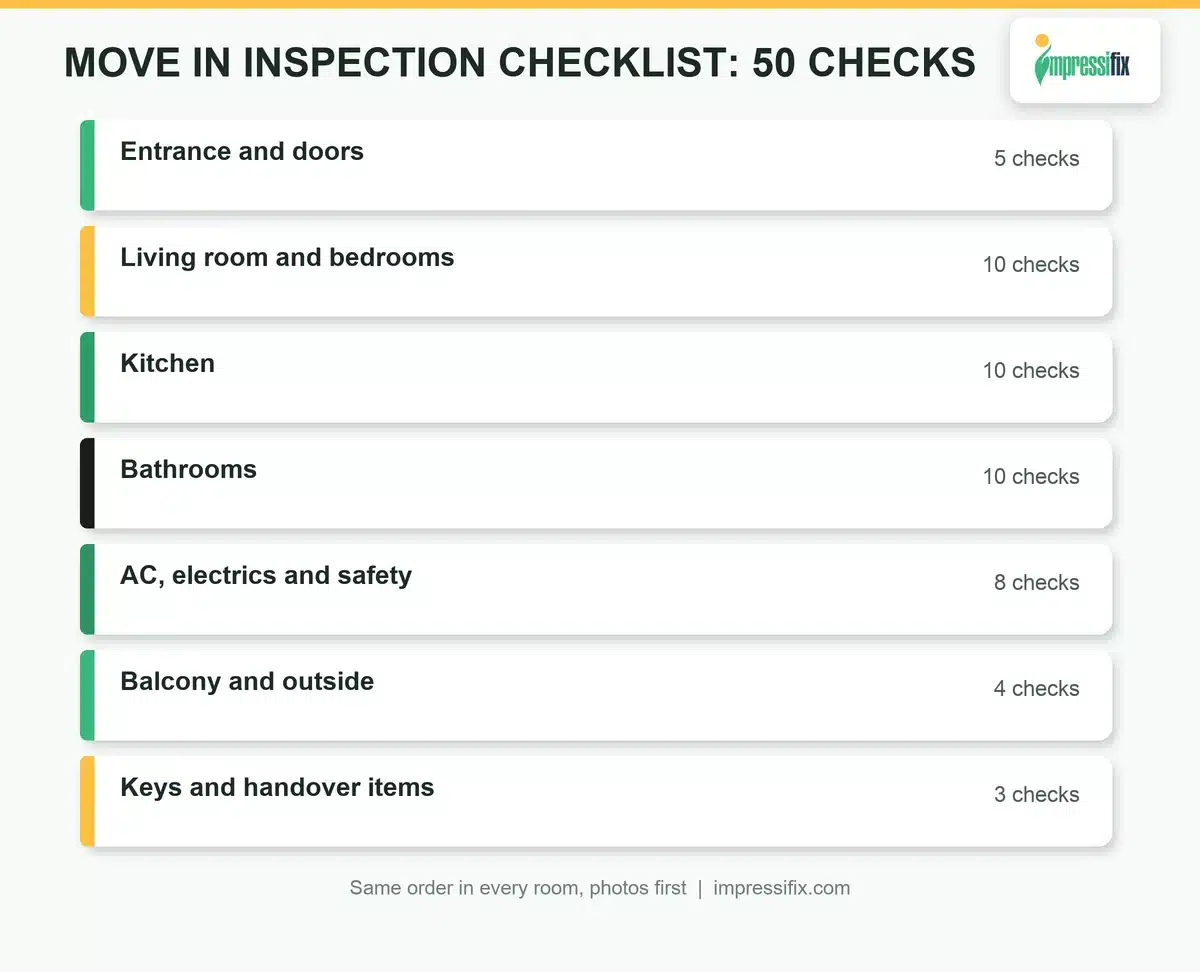
Move in inspection checklist Dubai: 50 checks room by room
Work through the home in the same order every time, and photograph each room from the doorway before you look at the detail.
Entrance and doors (5 checks)
- Main door lock, handle and deadbolt work with every key provided.
- Door closer, peephole, intercom and doorbell work.
- Internal doors open, close and latch without sticking.
- Door frames and skirting boards have no dents, scuffs or loose sections.
- Entrance floor and walls are free of marks and chips.
Living room and bedrooms (10 checks)
- Walls: shine the torch across them for hairline cracks, damp patches, peeling paint and nail holes.
- Ceilings: look for stains, cracks and signs of past leaks, especially under bathrooms above.
- Floors: tap tiles gently for hollow sounds; look for cracked tiles, gaps in the grout and scratched wood or laminate.
- Windows open, close and lock, and the seals are intact.
- Glass has no cracks or chips, including in balcony doors.
- Sliding balcony doors run smoothly and lock.
- Blinds and curtains, manual or motorised, open and close.
- Wardrobe doors, drawers, shelves and hanging rails are secure.
- Every light switch and ceiling light works.
- Every socket, TV point and data point works; note any cover that is loose or shows wiring.
Kitchen (10 checks)
- Run the tap for two minutes: hot and cold water, pressure and drainage.
- Put a dry tissue under the sink trap and pipes to find slow leaks.
- Hob: every burner or zone heats.
- Oven heats, the light works and the door seal is intact.
- Extractor hood: fan speeds, light and filter condition.
- Fridge and freezer cool and the seals close properly.
- Dishwasher and washing machine, if provided, run and drain.
- Cabinet doors and drawers open, close and sit straight; hinges are firm.
- Worktops and splashback have no cracks, burns or water damage.
- Silicone and grout lines around the sink and worktop are complete, with no black mould.
Bathrooms (10 checks)
- Hot and cold water at every tap and shower.
- Water pressure in the shower and hand shower.
- Basin, shower and bath drain quickly.
- The toilet flushes, refills and stops running.
- No cracks in the basin, toilet, bath or shower tray.
- No leaks under the basin or around the base of the toilet.
- Grout and silicone are complete, with no mould or gaps.
- The exhaust fan turns on and draws air.
- Mirrors, cabinets, towel rails and holders are fixed firmly.
- The water heater works and has no drips or rust.
AC, electrics and safety (8 checks)
- Every AC unit cools on each temperature and fan setting.
- Thermostats and AC remotes work; count the remotes.
- No drips, water marks or musty smells around indoor units and grilles.
- Ask whether cooling is from a central chiller or split units, as it affects your bills.
- The distribution board is labelled and no switch trips when you test.
- Smoke detectors are fitted and not covered.
- The building’s fire exits and the location of the fire extinguishers are clear.
- No signs of pests: droppings, egg cases or cockroaches in kitchen and bathroom cupboards. Ask when the unit was last treated.
Balcony and outside (4 checks)
- Railings and glass panels are secure.
- The floor slopes to the drain and the drain is clear.
- No cracked tiles or stained grout on the balcony floor.
- For a villa or townhouse: gates, garden taps, outdoor lights and any parking area.
Keys and handover items (3 checks)
- Count and record every key, access card, parking tag and mailbox key.
- Photograph the electricity and water meter readings with the date showing.
- Collect appliance manuals, warranty papers and the building management’s contacts.
How to record the move in inspection so it protects your deposit
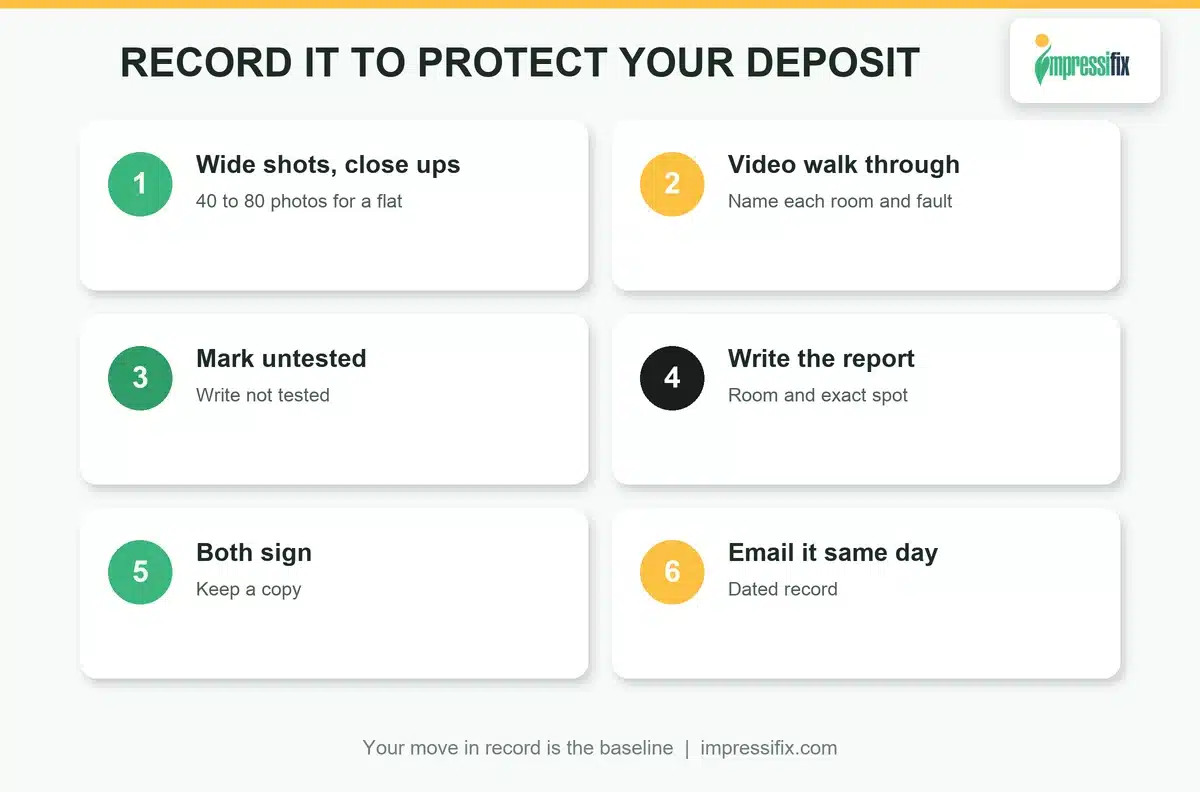
A checklist only helps if the record is clear and both sides agree to it. Use this order:
- Wide shot first, then close ups. Photograph each room from the doorway, then every scratch, chip, stain or fault from close up, with something in the frame for scale. For an apartment, 40 to 80 photos is normal.
- Video the walk through. A slow video with you naming each room and fault is hard to dispute later.
- Mark what you could not test. If the water or power was off, write “not tested” rather than assuming it works.
- Write it in an inspection report. Note each fault with the room and the exact spot, such as “master bedroom, left wardrobe door, hinge loose”.
- Get it signed. Ask the landlord or agent to sign the move in inspection report with you, and keep a copy.
- Send it the same day. Email the report, photos and video to the landlord or agent so there is a dated record, and keep the reply.
- Report anything you find later in writing, within the window your tenancy contract states.
Who fixes the faults you find at the move in inspection?
Under Article 16 of Dubai’s rental law, unless the parties agree otherwise, the landlord is responsible during the tenancy for maintenance and for repairing defects or damage that affect your use of the property. In practice, that means a broken AC, a leaking pipe or a faulty appliance that came with the home should be fixed by the landlord, and cosmetic marks are usually just recorded. Read your contract, because some contracts move minor maintenance to the tenant.
Ask for a repair date in writing before you move in, and check the fault again once it is fixed. If you rent outside Dubai, the rules of that emirate apply, so ask your landlord or agent which law and registration system cover your home.
Move in inspection, snagging or a move in clean?
| Job | When | Who it is with | What it protects |
|---|---|---|---|
| Move in inspection | Before you accept the keys of a rented home | The landlord or agent | Your security deposit at the end of the tenancy |
| Snagging | Before you sign the handover of a new build you bought | The developer | Your right to have defects fixed |
| Move in clean | After the inspection, before your furniture arrives | A cleaning company or you | A clean, healthy start in an empty home |
Do the move in inspection before you clean. A clean can hide marks you need on record, and dust or stains you photograph at the start count as the home’s starting condition. Our move in cleaning checklist shows what to clean, room by room, once the inspection is signed.
The move in clean after your move in inspection
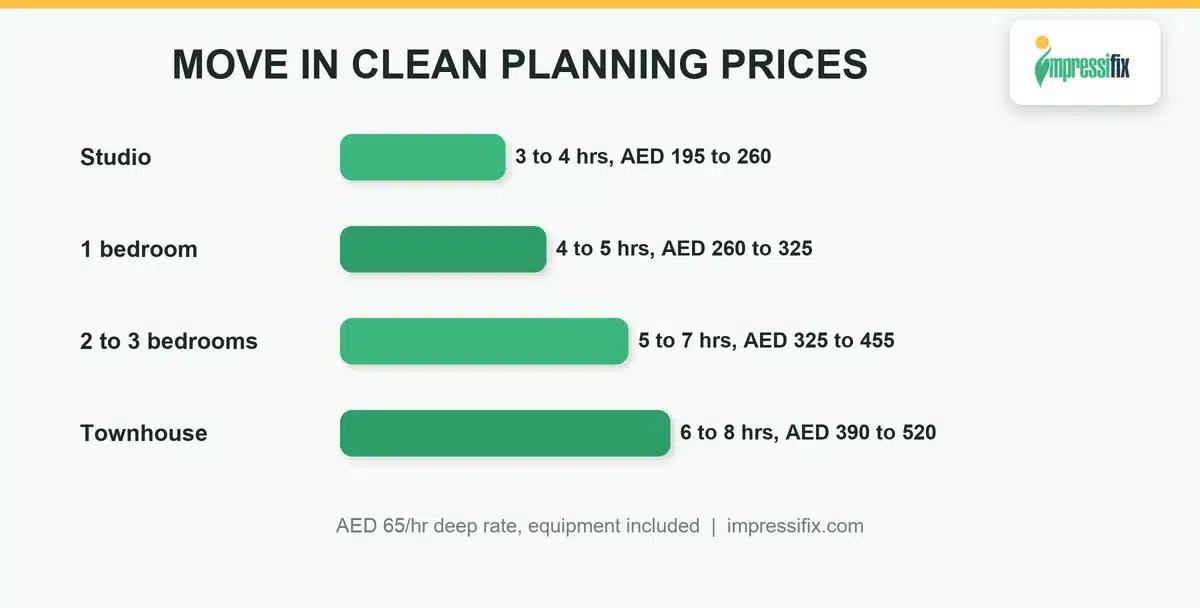
A move in clean is a deep clean of an empty home, charged at our deep cleaning rate of AED 65 per hour, the same in every emirate, with equipment and materials included. These planning figures use the typical deep clean hours from our guide to how long a deep clean takes; a home left very dirty can take longer, and your exact hours are confirmed before you book.
| Home | Typical hours | Planning figure at AED 65 per hour |
|---|---|---|
| Studio | 3 to 4 | About AED 195 to 260 |
| 1 bedroom | 4 to 5 | About AED 260 to 325 |
| 2 to 3 bedrooms | 5 to 7 | About AED 325 to 455 |
| Townhouse | 6 to 8 | About AED 390 to 520 |
If the home only needs a light refresh, a regular visit at AED 45 per hour, or AED 35 per hour for 4 to 8 hours, may be enough. Keep your move in photos safe: at the end of the tenancy, our end of tenancy cleaning service and our end of tenancy cleaning Dubai guide help you hand the home back in the condition you recorded, and our guide to who pays for end of tenancy cleaning explains what can fairly come out of a deposit.
Frequently asked questions
What should be included in an inspection checklist?
A rental move in inspection checklist should cover every room in the same order: doors and locks, walls, ceilings and floors, windows and balcony doors, wardrobes, every switch and socket, the kitchen sink, appliances and cabinets, bathroom taps, drains, toilet, grout and fan, every AC unit, the balcony, and the keys, access cards and meter readings. For each item, note its condition, add a photo and mark anything you could not test.
What should I check before moving into a new apartment?
Walk through in daylight with the landlord or agent and test everything before you sign: turn on every AC, run every tap and shower and look under the sinks for leaks, flush the toilets, test every switch, socket and lock, inspect walls, ceilings and floors for cracks, damp and loose tiles, open the wardrobes, look for signs of pests and count the keys and access cards. Send dated photos of any damage to the landlord or agent straight away.
What is a move out checklist?
A move out checklist is the list of jobs that get your deposit back when you leave: give notice as your contract requires, repair any damage beyond ordinary wear and tear, clean the home to the condition you received it in, settle and close your utility accounts, return every key and access card, and do a joint inspection with the landlord using your move in photos as the comparison. Our moving out checklist covers each step.
Book your move in clean or get a quote in 60 seconds
Tell us your emirate and area, your home size and your move in date, and we will confirm the hours and the price. To book, sign up for an account on our site first. Our team answers Monday to Saturday, 9:30am to 7pm.